

ABCDE method for EXECUTIVE ASSISTANTS
- EA FACTION
- Dec 18, 2025
- 3 min read

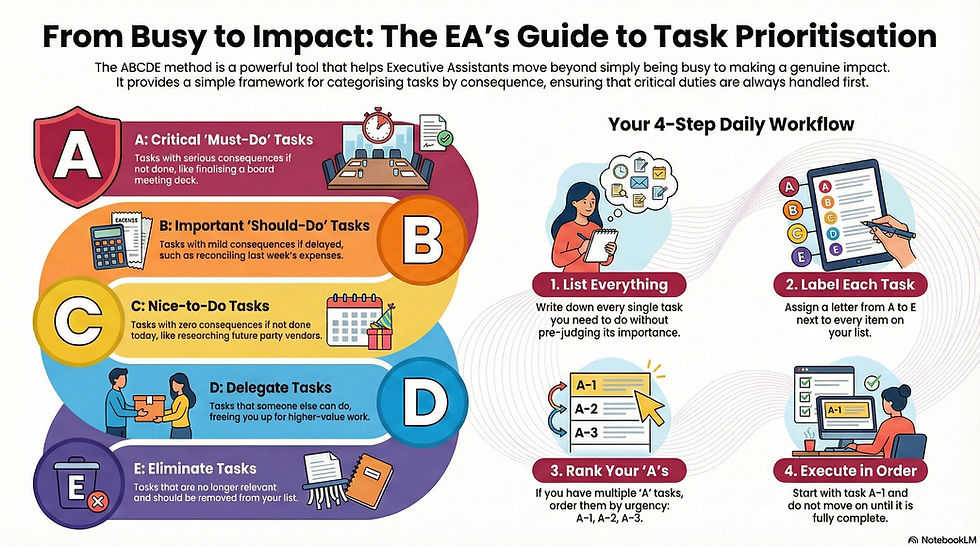
Does this sound familiar? You look at your to-do list in the morning, and it’s a mile long. You spend the entire day in a flurry of activity—answering emails, attending meetings, checking off small items—only to reach the end of the day feeling exhausted but not accomplished. This is the "busy" trap: a state of constant motion that produces very little meaningful progress on your most important goals.
The ABCDE Method is a simple but incredibly powerful framework designed to pull you out of this cycle. It forces you to move from a mindset of "busy-ness" to one of "impact" by transforming your to-do list from a random collection of tasks into a strategic daily plan. It’s a tool for ruthlessly distinguishing your true priorities from the distractions that drain your energy and time.
Here is how an EA applies this method to their daily task list to ensure optimum delivery.
🟢 A: Critical "Must-Do" Tasks
These are tasks with serious consequences if not completed. Failure to do these could result in a missed flight for the executive, a failed board meeting, or a damaged reputation.
The Mindset: "Eat that frog." Do these first thing in the morning.
EA Example: Finalizing the briefing deck for a 2:00 PM Board Meeting.
Consequence: If not done, the Executive walks into the meeting unprepared, causing a loss of professional credibility.
🔵 B: Important "Should-Do" Tasks
These are tasks that have mild consequences if not done immediately.2 They are important for the smooth running of the office but won't cause a "fire" if delayed by a few hours.
The Mindset: Never do a 'B' task when an 'A' task is left unfinished.
EA Example: Reconciling the travel expenses from last week's trip.
Consequence: Delaying this might annoy the finance department, but it won't stop the business from functioning today.
🟡 C: Nice-to-Do Tasks
These are tasks that would be pleasant to complete but have zero consequences for the business if they aren't finished today.
The Mindset: These are often "filler" tasks that we do to feel productive while avoiding harder work.
EA Example: Researching new potential catering vendors for a holiday party that is three months away.
Consequence: None. The office continues to run perfectly if this stays on the list for another week.
🟠 D: Delegate Tasks
These are tasks that someone else can do just as well as you, or tasks that are beneath your current pay grade/responsibility level but still need to happen.
The Mindset: As an EA, you are a manager of time.3 If you can't delegate to a person, delegate to a tool (automation).
EA Example: Standard data entry for the CRM or printing/binding 20 copies of a report.
The Action: Assign the printing to the office coordinator or intern so you can focus on Category A.
🔴 E: Eliminate Tasks
These are tasks that are no longer relevant or are purely "busy work."
The Mindset: Be ruthless. If a task doesn't contribute to your Executive's goals or your professional growth, get rid of it.
EA Example: Compiling a weekly "industry news" summary that your Executive admitted they haven't read in six months.
The Action: Stop doing it. Redirect that hour of work toward high-level project management.
How to Implement This Tomorrow
To achieve optimum delivery, an EA should follow this workflow:
Brainstorm: Write down every single thing you need to do.
Label: Place a letter (A-E) next to each item.
Rank: If you have multiple 'A' tasks, rank them A-1, A-2, A-3 based on urgency.
Execute: Start on A-1 and do not move to A-2 until it is finished.
Summary Table for Quick Reference
Category | Priority | Action | Example for EA |
A | Very High | Do it now | Emergency calendar conflict for the CEO |
B | Medium | Do it after A | Responding to non-urgent internal emails |
C | Low | Do if time permits | Updating the office "fun" Slack channel |
D | Transferable | Delegate | Ordering routine office supplies |
E | Unnecessary | Eliminate | Attending a meeting where you aren't needed |
Conclusion: From a List to a Strategy
The ABCDE method does more than just organize your tasks; it transforms your to-do list from a source of overwhelming anxiety into a strategic plan for daily impact. By consciously categorizing your work before you begin, you ensure that your effort is always directed where it can make the most difference, moving you from a state of being busy to one of being truly effective.
Looking at your to-do list right now, what is the one task you could 'Eliminate' tomorrow to make more room for your 'A'?


Comments