

Time Boxing Method: A Comprehensive Guide for Executive Assistants
- EA FACTION
- Dec 19, 2025
- 3 min read

What is the Time Boxing Method?
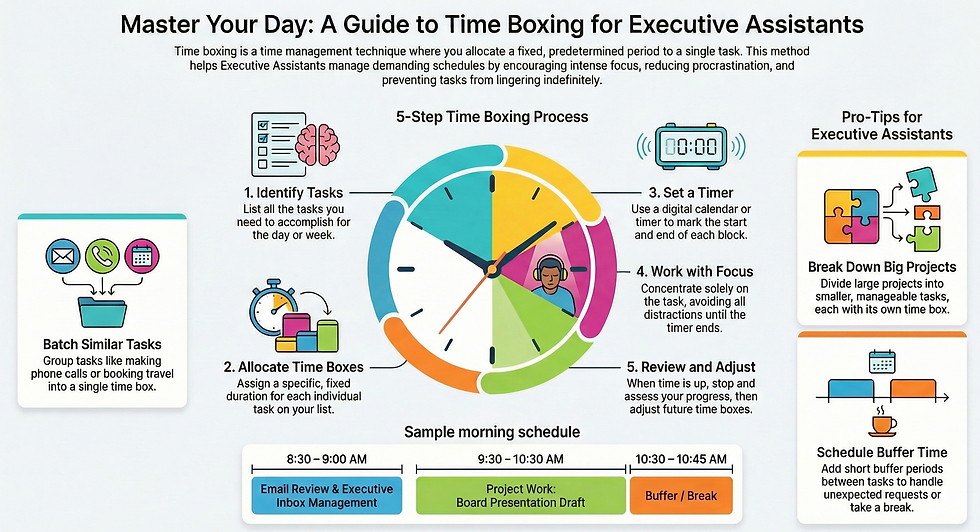
Time boxing is a time management technique that involves allocating a fixed, predetermined amount of time to a task or activity and then completing the task within that period. Unlike traditional to-do lists, where tasks may linger indefinitely, time boxing encourages focused work by placing boundaries around tasks, reducing procrastination, and preventing perfectionism from delaying progress.
How Does Time Boxing Work?
The process of time boxing typically involves the following steps:
1. Identify Tasks: List out all the tasks you want to accomplish.
2.Allocate Time Boxes: Assign a specific duration for each task (for example, 30 minutes for emails, 1 hour for preparing a report).
3.Set Timers: Use a timer or calendar event to mark the start and end of each time box.
4. Work with Focus: Concentrate solely on the task during its time box, avoiding distractions.
5. Review and Adjust: At the end of each time box, stop working on the task—even if it's not finished—and assess your progress. Adjust future time allocations as needed.
Benefits of Time Boxing for Executive Assistants
·Enhanced Productivity: By working within set time limits, tasks are completed more
efficiently.
·Reduced Procrastination: The fixed time frame creates a sense of urgency, making it easier to start tasks promptly.
·Better Prioritization: Allocating time boxes helps visualize the day and prioritize important tasks.
·Minimized Perfectionism: With a clear end time, there’s less temptation to over-polish tasks.
·Improved Work-Life Balance: Time boxing ensures that work does not spill over into personal time.
How Executive Assistants Can Leverage Time Boxing
Executive Assistants (EAs) juggle multiple priorities, support executives, and manage complex administrative tasks. Leveraging time boxing can significantly enhance their workflow. Here’s how:
1. Schedule Routine Tasks: Set daily time boxes for recurring activities such as checking emails, calendar management, and document preparation. For example, dedicate 8:30–9:00 AM to organize the executive’s inbox and 9:00–9:30 AM for updating the calendar.
2. Project Work: Break larger projects into smaller components and assign each a time box. For example, if planning an event, allocate 1 hour for venue research, 30 minutes for vendor outreach, and 45 minutes for drafting invitations.
3. Meeting Preparation: Use time boxing to prepare for meetings. Allocate 20 minutes to create agendas and 15 minutes to review previous meeting notes.
4. Buffer Time: Schedule buffer time boxes between meetings to handle unexpected tasks or urgent requests.
5. Task Batching: Combine similar tasks (e.g., phone calls, travel bookings) into a single time box to minimize context switching and maximize efficiency.
Practical Examples
Time | Task | Duration |
8:30 AM – 9:00 AM | Email Review & Executive Inbox Management | 30 minutes |
9:00 AM – 9:30 AM | Calendar Coordination & Scheduling | 30 minutes |
9:30 AM – 10:30 AM | Project Work: Board Presentation Draft | 1 hour |
10:30 AM – 10:45 AM | Buffer/Break | 15 minutes |
10:45 AM – 11:15 AM | Meeting Preparation: Weekly Team Sync | 30 minutes |
11:15 AM – 12:00 PM | Call Vendors for Event Planning | 45 minutes |
Visual Example: Time Boxing Calendar
Below is a conceptual example of how time boxing can be visually represented in a calendar:
Figure 1: Time boxing blocks in a digital calendar
Tips for Successful Time Boxing
· Start with realistic time frames—avoid over-scheduling.
· Use digital calendars or time tracking apps to set and monitor time boxes.
· Be flexible; adjust time boxes as priorities shift during the day.
· After each time box, review what was accomplished and update your plan as needed.
· Communicate your schedule with your executive to align on priorities and availability.
Conclusion
Time boxing is a powerful technique that Executive Assistants can use to manage their day more effectively, boost productivity, and better support their executives. By consciously allocating time, focusing on one task at a time, and using visual tools like calendars, EAs can transform the way they work and deliver even greater value.


Comments